
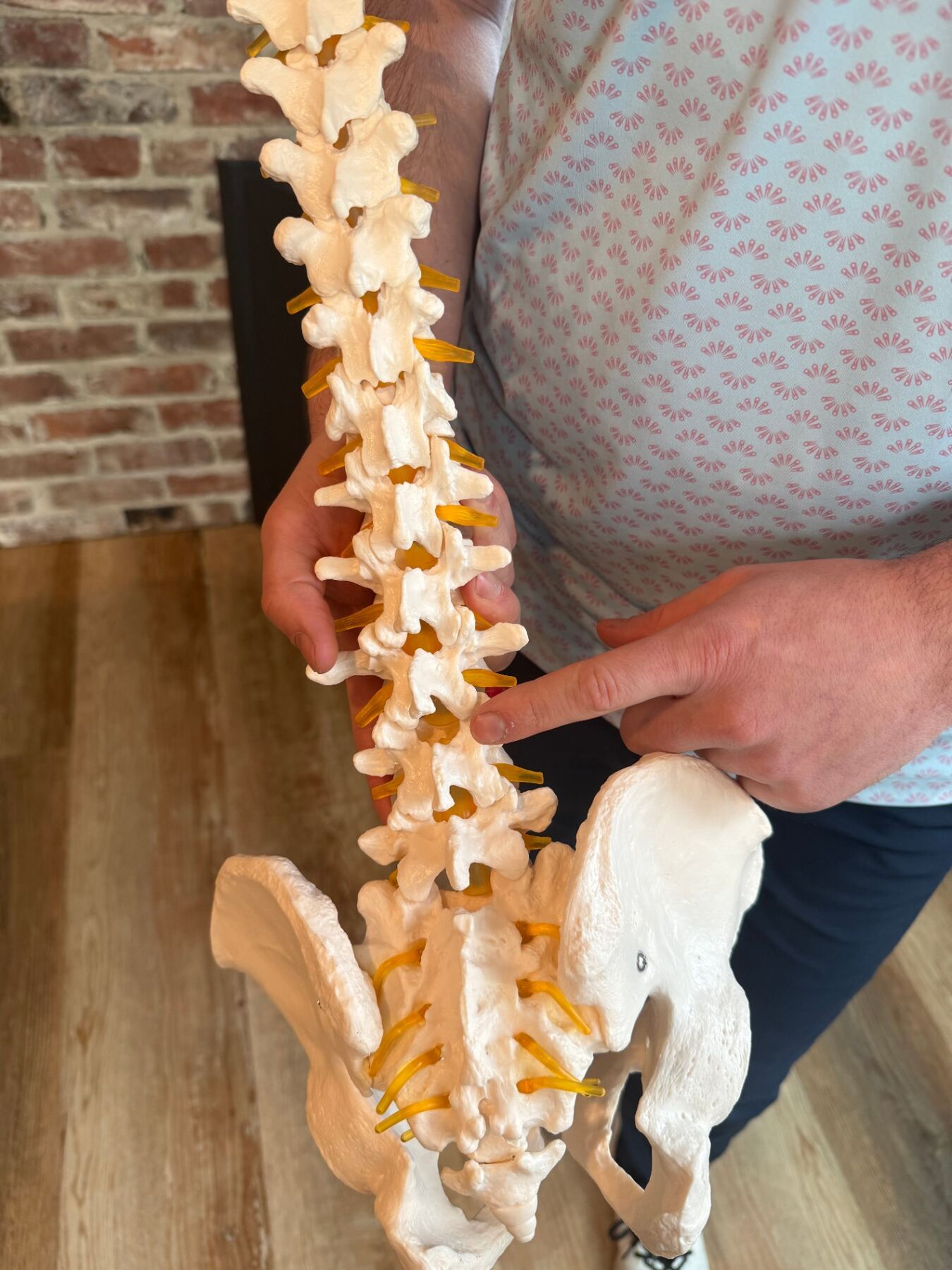
You spent your 20s and 30s handling everything. Kids, career, moves, three-hour trips to Costco with a car full of groceries and no complaints. Then somewhere around 42 the back that used to bounce back overnight started staying tight for days. This isn't in your head, and it isn't "just aging." Here's what actually shifted — and what reverses it.
What Changes In Your 40s That Wasn't True At 30
Four things quietly stack up between 30 and 45. Each one is minor on its own. Together, they turn a niggle into a "why am I moving like my mother" morning.
- Disc dehydration. Spinal discs lose water content starting in your 30s. By 40, that lumbar disc has less shock absorption, so the same lift feels heavier to your spine.
- Sarcopenia. You lose ~1% of muscle per year after 30 unless you actively train. The deep spinal stabilizers are usually first to go — and they're exactly the muscles that keep your low back happy.
- Hormonal shifts. For women, perimenopause changes collagen quality and joint laxity. For men, testosterone decline reduces the tissue's ability to repair micro-damage.
- Ten more years of desk posture. The forward-head, rounded-shoulder pattern you've been sitting in since your 30s becomes structural. The curve in your neck flattens, your ribcage locks down, and your low back has to compensate.
Why "Just Stretch More" Isn't Working
Stretching a muscle that's tight because it's working overtime to hold a joint stable doesn't help — it makes the joint even more unstable, which makes the muscle grip harder the next day. If your low-back stretches feel great for 20 minutes and then it's worse, this is why. Your body isn't being dramatic. It's protecting something.
What Actually Reverses It
Three things, in this order:
- Fix the structure first. An exam should tell you whether the curve of your lumbar spine is where it should be, whether your pelvis is level, and whether specific discs are compressed. That's what Chiropractic Biophysics and spinal decompression address — the physical alignment, not just the pain signal.
- Then rebuild the muscles that hold that structure. Twenty minutes, twice a week, of targeted core and glute work does more than an hour of general cardio. You don't need a bodybuilding routine — you need the right five exercises.
- Fix the daily setup. Chair height, monitor height, how you sit in the car, which side you sleep on. Small structural inputs, running eight hours a day, beat any 30-minute workout.
The Bellingham 40-Something Pattern We See Every Week
Most of the women who walk into Envision in their 40s say some version of the same thing: "I finally decided to do something about it." They've been pushing through for years. When we actually do the exam, the imaging tells a very consistent story — a lumbar curve that's flatter than it should be, one hip riding higher than the other, and disc spaces that are noticeably compressed at L4-L5. It's not a mystery. It's a pattern. And it responds well.
If this sounds like you: it doesn't have to keep getting worse. A single evaluation tells you exactly what's going on. Most patients feel meaningful relief in the first two weeks, and the structural change locks in over the next few months.